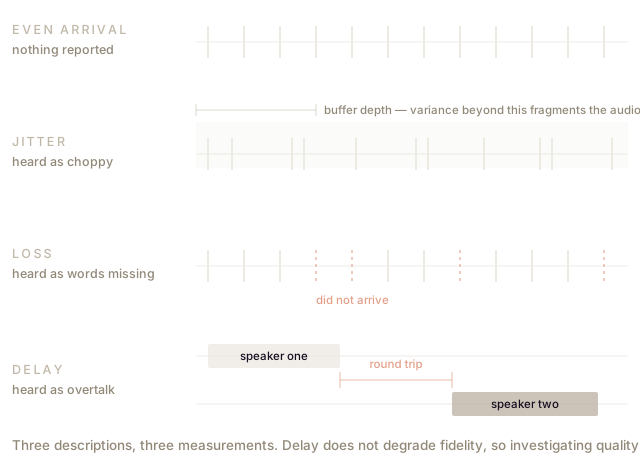
Symptom to metric
Jitter is variance in packet inter-arrival timing. A buffer absorbs variance up to its depth; beyond that audio fragments into short gaps, reported as choppy or robotic.
Packet loss is non-arrival. Concealment masks low levels; above roughly one to two per cent, syllable-level dropout occurs and is reported as words going missing.
Round-trip time is delay. It does not degrade fidelity at all. Beyond roughly three hundred milliseconds it disrupts conversational turn-taking and participants talk over one another. A report of that symptom is a latency fault; investigating quality will not resolve it.
Identify the layer first
A blocked call is a connectivity fault: capacity, not quality. A call that connects but sounds wrong is also connectivity, but a different sub-boundary — transport or route selection.
A call that connects, sounds fine and reaches the wrong place is a control fault, and no amount of jitter analysis will help. A number that cannot be reached at all is a numbering fault. Something that worked last week and does not now is, in most estates, an operation fault.
Identifying the layer takes thirty seconds and removes most of the search space. It is the practical dividend of building this way.
Then find the common factor
Within the connectivity layer, establish what the affected calls share: one user, one site, one destination, one direction, one time period.
A single user indicates a local network or endpoint. A whole site at a consistent time indicates access circuit contention, which predominates by a wide margin. A single destination indicates an upstream route. A single direction indicates asymmetric access capacity, characteristic of consumer-grade connections.
Traffic prioritisation missing, or applied at the endpoint and not honoured by an intermediate device, is the second most common. Wireless roaming contributes frequently for soft client users.
Why records settle it
Without per-call metrics, a quality investigation is a reconciliation of recollections and frequently ends without resolution.
With them it is a query: select calls exceeding the jitter buffer threshold, group by site and interval, and the distribution generally identifies the condition immediately.
That is why jitter, packet loss, round-trip time and completion cause are retained for every call across every layer.